21 Oct 2014
 Posted by admin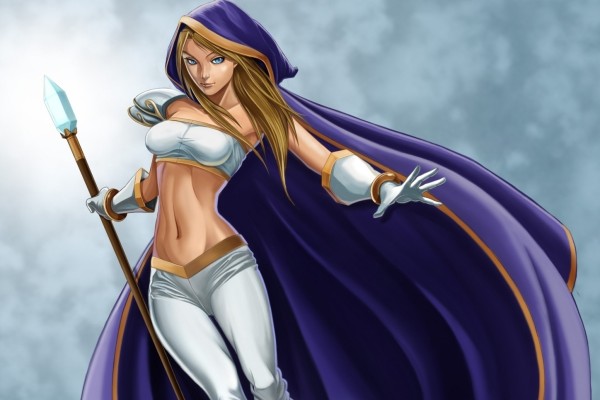
TThere’s a perception that video game heroes are burly white guys who solve everything with giant weapons and excessive violence. Unfortunately, there’s a lot of truth to this very narrow ideal, but not all games conform to it. The following are some of the best examples of unconventional video game heroes.
10: Billy Candle, “Call of Juarez”

It’s a sad commentary on the state of the video game industry to be praising a game purely because it features a hero of Hispanic descent, but that’s where things are. Billy Candle of 2006’s Western shooter “Call of Juarez” stands apart in a field of predominately white action stars as a man of Mexican descent, a heritage that sees him the victim of much prejudice from the game’s other characters. When his mother and stepfather are murdered, Billy is fingered as the killer and must flee undue punishment. Ultimately exonerated, he helps to bring the true murderer to justice.
9: Jaina Proudmoore, “Warcraft III”

The most powerful magician in the Warcraft universe, Jaina Proudmoore holds her own in a fight, which she demonstrates many times in-game. But she’s not a fighter at heart; she’s a scholar and a diplomat who always tries to find a peaceful solution. Later games have made questionable choices regarding her character, but in her “Warcraft III” incarnation, she was someone any young girl could look up to: brilliant, brave, tolerant, and kind.
8: Ico, “Ico”

The title character of a minimalist puzzle-platformer, Ico is a young boy banished from his village because of a deformity. Locked in a haunted castle, he encounters a girl named Yorda and helps her to escape an evil queen, guiding her through the obstacles within the castle and fighting off shadowy creatures that seek to recapture her. Not just an unusual hero for a video game, but an unusual hero period, Ico proves that heroism can come in any form.
7: Jax Briggs, “Mortal Kombat” franchise

Black characters don’t really have a strong history in video games. They’re usually very minor and utterly stereotypical bad guys, if they’re included at all. But Jax Briggs has a fairly prominent role in the “Mortal Kombat” universe, and not a villainous one either – he’s a brave and capable soldier with a fierce loyalty to those under his command.
6: Aveline de Grandpré, “Assassin’s Creed: Liberation”

Praise for diversity in an “Assassin’s Creed” game, considering the recent flap over Ubisoft claiming it would be too much of a technical challenge to include female avatars in “Assassin’s Creed: Unity,” may come as a surprise. Past parts of the series were better.
The main character of “Assassin’s Creed: Liberation,” a half-black woman named Aveline de Grandpré, is a gender-bending figure who dresses in male clothes and is even referred to with the male pronoun at some points in the franchise. Through clever use of outdated slang, the game’s writers also imply a romantic relationship – or, at least an attraction – between Aveline and another prominent female character in “Liberation,” Patience Gibbs.
5: Louis, “Left 4 Dead”

Louis is one of four playable survivors in the co-op zombie shooter. As mentioned, black characters usually aren’t portrayed in a positive light in video games – when developers bother to include them at all. Louis however, is pleasantly free of racial stereotypes, negative or otherwise. A very normal and likable everyman, he has an IT analyst background prior to being caught up in the zombie apocalypse.
4: Nilin, “Remember Me”

Nilin, star of this intellectual sci-fi brawler, is an unusual hero for a video game. Not only a woman, but one of half French, one quarter Ethiopian, and one quarter South Asian heritage. She’s such a departure from the norm, “Remember Me” almost failed to find a publisher because many believed she would not be marketable. But she is a solid character. Strong and capable but also human and vulnerable, it’s refreshing how the game treats her gender and ethnicity as complete non-issues. Sometimes, the strongest message is the one unspoken.
3: Chell, “Portal” franchise

Chell is something of a question mark. She has no dialogue, and players learn almost nothing about her as they work through the “Portal” games, but she’s still managed to become a fairly iconic figure. Another mixed race character; her appearance is based on the partly Brazilian, partly Japanese actress Alésia Toyoko Glidewell. “Armed” only with a portal gun that allows her to bend space to overcome obstacles, Chell solves problems purely with her mind.
2: Jade, “Beyond Good and Evil”

Jade is an unusual character from an unusual game. The operator of an orphanage on an alien world, she works as a freelance photojournalist to help pay the expenses of the children under her care. Over the course of “Beyond Good and Evil,” she uncovers a government conspiracy and defeats a race of hostile aliens, thus saving her orphans and an entire planet. While she is an expert martial artist and can handle herself in a fight, she’s just as comfortable solving problems with her investigative skills. Another interesting facet of her character is her ethnic ambiguity. She resembles all races to some extent, allowing for anyone to relate.
1: Faith Connors, “Mirror’s Edge”

The lead character of this parkour game, Faith, a woman of mixed white and Asian descent who relies more on speed and cunning than sheer brute to achieve her goals, is about as far from the stereotypical video game hero as you can get. But she is no less a hero than any gun toting space marine. When her twin sister is framed for murder, Faith faces death and danger to free her and undermine the Orwellian government that controls their city.