28 Aug 2014
 Posted by admin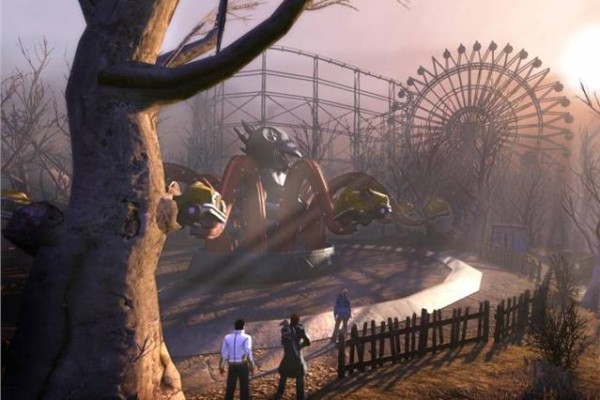
TThese days, video games aren’t just virtual arenas to test player skill. Many also provide rich and immersive story-telling experiences to rival film, television, and literature.
One of the better examples of this is “The Secret World,” a massively multiplayer online role-playing game from Norwegian developer Funcom. Unlike the generic fantasy settings used by many of its competitors in the genre, the horror-based works of writers like H.P. Lovecraft and Stephen King inspire “TSW.”

“The Secret World” writer Joshua Alan Doetsch is also known to his fans as “Scrivomancer.”
One of the brains behind “TSW’s” twisted lore is lead writer Joshua Alan Doetsch – known to fans by his forum handle “Scrivnomancer.” ADANAI sat down with Doetsch to discuss the life of a video game writer, the unique challenges of the medium, his work with TSW, and Funcom’s other MMO “Age of Conan.”
ADANAI: Explain a bit about what your job involves. What does an average day in the life of a video game writer look like?
Joshua Alan Doetsch: Every morning, a cult of gameplay designers draws a ritual circle in chalk, blood, and grave wax, summoning me with a blasphemous rite. Then we have a morning meeting. They compel me to give them text, careful not to break the circle, careful not to get too close…
Hrmmm…officially, I drive into work at about 10 a.m. and work till 6 p.m. That’s the loose plan. In actuality, things fluctuate and I tend to work a bit of overtime here and there. Since coming down to Durham [North Carolina], my duties have broadened somewhat. Things I might spend time on include:
- Taking a peek at the game forums. I keep more of a web presence than I used to back in Montreal and Oslo.
- Talking with other devs (gameplay designers, quest designers, artists, etc.) about text they need or answering questions about the lore and setting.
- Chatting with Game Director Joel Bylos deep into the far flung future of the “Secret World’s” storyline. I have peered into the abyss!
- Writing up descriptions of characters for our Wiki. Receiving concept art on the things I’ve described.
- Trying to remember that the favoured language for “TSW” is British English, and the favored language for “AoC” is U.S. English…and confusing the hell out of my computer’s spell check.
- Meetings! Sometimes dev-wide discussions about upcoming playfields or planning.
- Researching odd, random seeming bits of world lore or mythology, like double-checking to make sure that some people did believe that jade stone was actually petrified dragon semen. No weird knowledge goes wasted. And yes, if the authorities ever look at my search history…I may be in trouble.
- Writing! Writing dialogue for cinematic scenes. Writing faction mission reports. Writing item descriptions. Coming up with names for spreadsheets full of clothing items. Whatever sort of text might be needed.
- Though it’s slowed down lately, I used to spend a good chunk of time role-playing with players on Twitter. We called it our Twitterverse experiment. It was fun, educational, and I’m not sure anyone else was doing anything like it at the time. I’m a bit bogged down with game text and a lack of manpower now…but will get back into the Twitterverse when I can.
- A new duty I’ve picked up in the last year is working with the voice recordings. I now help direct the voice actors. I do this over Skype with sound studios (mostly in LA and London).
On Fridays, if we’re not crunching too hard, it’s encouraged for employees to play one of our games for a few hours during work time. Some Fridays we have beer Friday. It’s a very social company.
What unique challenges or advantages are there to writing for games as opposed to other mediums?
Challenges! One is brevity. In game writing you often have to fit quite a bit of story into tiny, odd blocks of text. Economy of word use becomes important. These small blocks of text take on all manner of forms: cinematic dialogue, artifacts (found letters, diaries, computer entries, etc.), phone calls, and advertisements for fictional companies (to name a few).
You often have to work under very arbitrary-seeming restrictions. Words have to get cut, whole bits of writing scrapped, because a certain program can only have X lines of text, or we weren’t able to cast any children, or the object drawn doesn’t match what you described, etc. It can be frustrating if you don’t keep a flexible head.
The advantages? Actually, it’s some of the restrictions I listed above, if you can take advantage of them. I kind of like not-quite-linear storytelling. It’s stippling storytelling. You place all these dots and let the viewer draw the lines. It appeals to me.
Also, restrictions are one way for creativity to happen. You form your own restrictions: every line will rhyme, or this story will contain no dialogue, or this character will speak entirely in 1920s slang. Having no restrictions can be paralytic to me sometimes. Write anything you want! When you have some restriction, it instantly creates a logic problem that your brain automatically begins solving. Suddenly you come up with creative decisions you would have never reached otherwise. Restrictions, if you let them, become the irritants that form pearls.
What’s the best part of being a video game writer?
I grew up a gamer, so my inner fan really thrills at getting to work in the medium. Another bonus is the people I work with. Writing can be a lonely endeavor, with no one around to even listen to the merry percussion of your head banging into the wall…so getting to work on a creative team can be great fun. Also, creative energy is catchy. I often get recharged when I see new concept art or hear music that’s going into game or see a playfield. We all kind of feed each other.
Also, the players. The Internet can be a scary place for game devs, but I’ve lucked out with being able to socialize with a great crowd of dedicated and creative players. They make this all a blast. Thanks folks!
What’s the worst part of being a video game writer?
Working in a collaborative project means compromises…and sometimes compromises can be frustrating. It’s usually not a problem for me. I’m pretty good at being able to work on something with someone else’s specifications and still make it my own.
Crunch-time can be rough. It’s especially rough on such a small team. Lots of extra, odd hours. During heavy crunch, it can be hard to keep the fun in it (which is a shame, because it’s a fantastic job to have). But you have to take a step back and put the fun back in. If you’re not having fun writing it, they [the gamers] likely won’t have fun reading it.
How did you come to be a video game writer?
There I was, just out of grad school. Master’s degree fresh off the press. Then…BAM! I’m living with my parents, working graveyard shift at 7-11, not even making the minimum payments on my massive debt.
Nothing has ever motivated me as much as a job I hated. I had to get out. I got it into my head that video games actually pay their writers. So I spent weeks looking up hundreds of companies. I put those companies into a prioritized list. I sent out at least three-dozen writing samples and resumes, tightening them up each time. Funcom eventually bit.
Though, they did not bite at first. Originally, I applied for a job on “The Secret World” (years before launch). I got up to the point that they had me do a writing test, but I was passed on the job. My resume and test stayed on file though. A job came up for “Age of Conan” months later and Joel Bylos interviewed and hired me. It was a fast turn around. Barely a month later, I left Chicago and was on my way to Oslo, Norway.
What’s it like to play a game that you helped to create?
It’s kind of odd. Definitely fulfilling. It’s still fun because so much of it is material that I don’t directly work on. I still play “TSW” and “AoC.”
Do you spend much time gaming yourself? If so, what are some of your favourite games to play, other than the ones you work on?
I used to game a lot more. Now, I’m very busy writing (both my day job and side projects). But I still make sure to game. Besides Funcom’s games, I’ve been playing a bit of “Diablo III” lately. It’s an easy one to jam on for short bits of time (and play with friends), preferably to a playlist of Rob Zombie, Dethklok, and Fantômas.
I play a lot of pen ‘n’ paper role-playing games. A lot of my earliest storytelling and character creating lessons come from the hobby. Currently, I play every Tuesday night with a group of Funcomers. The game alternates every other week between a heroic “Pathfinder” game, and a [“Dungeons and Dragons”] game where we all play various demons doing ridiculous mayhem and evil on the material plane. I seem to be a much more successful incubus than a hero…
I also go to GenCon every year for some LARP [live action role-playing], gaming, and merrymaking. I just got into “Magic: The Gathering” at the last convention
For those who aren’t familiar with it, what sort of game is “The Secret World”? What makes it unique compared to other massively multiplayer games, in your view?
“The Secret World” is a mixed-genre MMO that takes place in a modern world full of supernatural conspiracies. What makes it fairly unique is the “real”-world-setting… Characters see the same movies we do, wear similar clothes, and are otherwise very relatable.
There is this lovely distorted bend between the game’s reality and our own. Some investigative missions require the player to look for clues on the Internet. There are websites for some of the fictional companies and individuals. Real world mythology and urban legends seep into the game’s story.
That means we can do things like Twitterverse. A number of role-playing players have Twitter accounts for their characters. Where in some games, this would need to be explained as a magical or sci-fi communications device — “TSW” exists in the modern world. Characters actually have Twitter accounts. It’s grown into a pretty large community. I and a few other devs have joined in, making Twitter accounts for official non-player characters. Players actually get to role-play, not only with NPCs, but the devs. That’s a pretty unique gaming experience.
It’s obvious from your writing that you’re a big fan of H.P. Lovecraft. What other writers have influenced your work?
Edgar Allan Poe was my big influence from way back. He’s the guy that taught me that old books were cool. Neil Gaiman certainly is an influence, as is Ray Bradbury. Epic poems and comic books were a big influence too. And a touch of noir fiction (particularly Raymond Chandler). Let’s not forget comic books.
Another big influence was those pen ‘n’ paper RPG books. “Vampire: the Masquerade” and other White Wolf games had a huge influence on me as a storyteller.
What are the key differences between writing for “Age of Conan” versus “The Secret World”?
The settings are a bit different in tone. Also, [with “AoC”] I had a sort of blue print as far as style. I digested a lot of Robert E. Howard’s writing at the time. I supplemented that with The Epic of Gilgamesh to get into the right sort of language.
Another big difference is that almost all of the dialogue I write for “TSW” is voice recorded. Most of “AoC’s” was not. That put a lot fewer pressures and restrictions [on me] for the Conan stuff.
“The Secret World” is renowned for its memorable characters. What are some of your favorite characters to write for and why?
Kirsten Geary is certainly a favorite. I play her on Twitter as well. She benefits from an awesome voice actor. Something about a ruthless woman plotting world wide conspiracies while listening to old school hip-hop…
Said is a favorite. What’s not to like about a dapper mummy in a suit, running a criminal empire from his smartphone?
I haven’t had the opportunity to write for Hayden Montag, Headmaster of Innsmouth Academy yet, but would really love to.
For those who don’t know, what’s a scrivnomancer?
That’s my made-up word. A computer program I like to use for writing is Scrivener. If you like to write, check it out. A scrivener is someone who writes words. “Mancer” denotes a practitioner of certain dark arts. Presto!
Finally, what advice would you give to someone looking to break into the field of writing for video games?
A few notes on my strategy and what I learned:
- It’s a numbers game. Send out lots of stuff. I only heard back from a few companies and that was mostly to be told “No.” It takes just one person saying, “Yes.”
- That barrier of one year of experience (or one shipped game title) can be hard to leap over. In the U.S., I found companies were not as interested in my education. Funcom was much more interested in my master’s degree. If you work outside your home country, your employer must prove that they need to hire you (as opposed to a local) to get your work visa. Education is much easier to document than experience. Consider working abroad. Now I have the experience and published game writing, so it’d be much easier to find a job anywhere.
- A good exercise is writing one Twitter story a day. These are stories in 140 characters, posted on a Twitter account. It’s not easy. It teaches economy of language. It teaches to write under very strict restrictions. These are good skills to develop. It’s like writing crunches. And if a story fails, it’s not all that much time invested. You’re on to the next one. It also offers the quickest thing to instant gratification you can find in writing. Try one!
- Dig out your favorite games. Pay attention to the text in them. Some of my favorite game dialogue came from the “Legacy of Kain” series. I still go back and listen to bits of that.
- Absorb a lot of story. Read fiction. Read non-fiction. Listen to audio books when you do the dishes or during your commute. Feed that muse.