01 Mar 2013
 Posted by Whitney
SSure, you came to Grand Theft Auto for the crime sprees and carjackings, but you stayed for the cinematic story and great performances. For that you can thank Navid Khonsari, the Iranian-born filmmaker who directed the voice-over and motion capture on Max Payne, GTA III, GTA: Vice City and GTA: San Andreas to name a few. Now the Grand Theft Auto Director is back with a game about his homeland: 1979, a stealth actioner set in the fateful year when revolution ravaged Iran, coming soon to your tablet and smart phone.
Who better to explore Navid’s past and future than a fellow Rockstar: me!
JZ: I think most Americans have a murky view of Iran in their head as some ancient, theocratic culture. In 1979, what kind of details about Iranian culture will surprise western gamers?
Navid Khonsari: I think we have a black and white understanding of historical events in Iran. There was a revolution, the Shah was overthrown, Khomeini comes into power, hostages… 30 years later we’re the axis of evil.
Iran before the revolution was quite modern. Same music as the West, same fashions, bell bottoms. I never saw my mother cover up. If you take a look at her passport picture from 1978, she looks like a modern young woman that could be living in San Francisco, London or Helsinki.
After the revolution, for the next 30 years, the clocks get turned back. Take a look at her passport 20 years later, she’s got no makeup. She had to cover up.
So when we have discussions about whether to bomb Iran, we’re not bombing a country back into the past. Iran was on the forefront of modernism and maybe that’s part of the problem. It got too modern, too quick, but it had an infrastructure and one of the most educated populations in the world.
But I don’t want to educate people. I want to entertain. In the process of entertaining, I can provide an insight into why there’s been a black and white relationship between the west and Iran over the past 30 years.

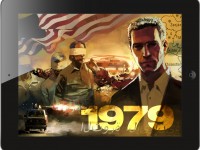
iPad screenshot from Grand Theft Auto director Navid Khonsari’s upcoming release 1979.
You said 1979 won’t have any shooting in it. When I first heard of it, I automatically pictured it as a First Person Shooter, aiming sniper rifles on embassy windows and what not. Have years of GTA clones numbed you to violence? Did you make a conscious choice to steer away from it being just another killing simulator?
I’m not avoiding it; I’m being true to the story. Weapons in Iran were illegal. For revolutionaries to grab weapons, they had to break into the soldiers’… what do you call them, barricades?
Right. No! Barracks.
Barracks, right. And when you see most revolutions take place, weapons are not needed. It’s much more about stealth. The last thing you want to get is the attention of the military so they start shooting at you.
Also, I haven’t come across anything that’s good in the FPS genre for tablets or smart phones. I’m not opposed to shooting, but I feel that [game designers] who go to shooting automatically miss out on creativity and imagination in gameplay.
A lot of games try to make us so powerful with so many weapons to overcome our enemies. But I want to see what I would do if I was in that situation. That’s exciting. Getting arrested or getting smacked down when you’re aggressive is a much better and truer reflection and can still be amazingly entertaining because you really have to watch your step, instead of just bulldozing your way through it.
My favorite Rockstar game was Manhunt – sometimes just putting the controller down and waiting for that bad guy to pass as you hide in the shadows was a thrill.
Yeah, Manhunt is a huge influence on this game.
This was a revolution where there’s curfews, martial law, a fight against a dictatorship, so I’m not going to pull back on the aspect of violence or death. I don’t want to make light of that, but certainly if there’s a curfew in NYC, we would probably sneak through shadows, hide behind cars, with military out and about on the streets.
The first part of the game is called Revolution. You’re dropped in a protest in Iran, a non-violent protest that was referred to as Black Friday. It was the first time that the military actually shot at civilians. At that moment the game starts. What happens during this moment? How they did overcome the military that had weapons?
Who’s your favorite actor you worked with in a video game?
I was taken back by the performance, skills and humility of Dennis Hopper. Working with that guy was amazing.
What did he do? I forgot.
He was the porn director in Vice City.
Oh right, the porn director.
He recognized I knew the world and environment he was about to partake in.
The porn world?
Yeah, exactly. (Laughs.) Like many people that come into the VO booth, as you know, they don’t know how to go about performing for a video game. They think it’s animation, so they act in an animated way. Some lean on you to take them down the path, others don’t even want to listen to you and they do it their way no matter what. Dennis was just very open to direction, very humble. When I gave him direction not only did he hit it but he just, y’know, surpassed my expectations.
Another great actor is a guy named Matthew Peretta. He was Alan Wake. As far as I’m concerned he’s the quintessential “working actor.” He’s just a professional as any celebrity, hard working, nailing the performance. He brought no ego to the table, and he let me take him down the road. You want your actor to be comfortable enough so you can steer him the right way.
Who’s the worst behaved actor you worked with in a game?
They’re all there to get paid. In the end we always make it happen.
Burt Reynolds gave us some trouble in the studio, but in the aftermath, we recognized that he did a great job. Avery Carrington is a great character in Vice City.
If you got the performance in the can, that’s all you need.
Four hours in the voiceover booth can equal a great experience for people playing the game.
All of my friends who worked at Rockstar were hired through a “happy accident.” A chance encounter at a house party, meeting a friend of a friend at a bar. I don’t know anyone who did the traditional route of sending a resume and a cover letter in a nice manila envelope.
If you get an eager person asking “How do I get in the video game business?”, how do you respond?
It’s like anything, you know. It’s about perseverance. It’s about passion. If you want that job bad enough, you have to get in. You have to be humble too, about what you’ll get and the recognition you’ll achieve.
Just because you like video games, doesn’t mean you should get a job in video games. Making video games is a lot different than playing video games. You know?
Even having that QA position, where you’re actually playing video games day in and day out, is so psychologically taxing.
Yeah. If you want to get into games because you’re intrigued by design, animation, music, acting, if you like those elements and say “I wouldn’t mind doing those for video games” then you got something to talk about. If you say, “Man, I love playing video games. I’m going to go make some video games.”, the reality is there’s no depth to your request.
In Part 2 we discuss 1979’s ‘baton-pass’ narrative, Navid’s favorite Rockstar game (it’s a three way tie) and his new graphic novel Bedouin.
For more on Navid Khonsari, check out his site inkstories.com.
John Zurhellen writes video games for Rockstar Games, Activision, and other great developers.